Prompt Injection: How Hidden Text Hijacks AI Agents

Read Article
Most "AI agent" vendors are rebranded chatbots. Use these questions, red flags and a checklist to choose an AI agent development company that ships.
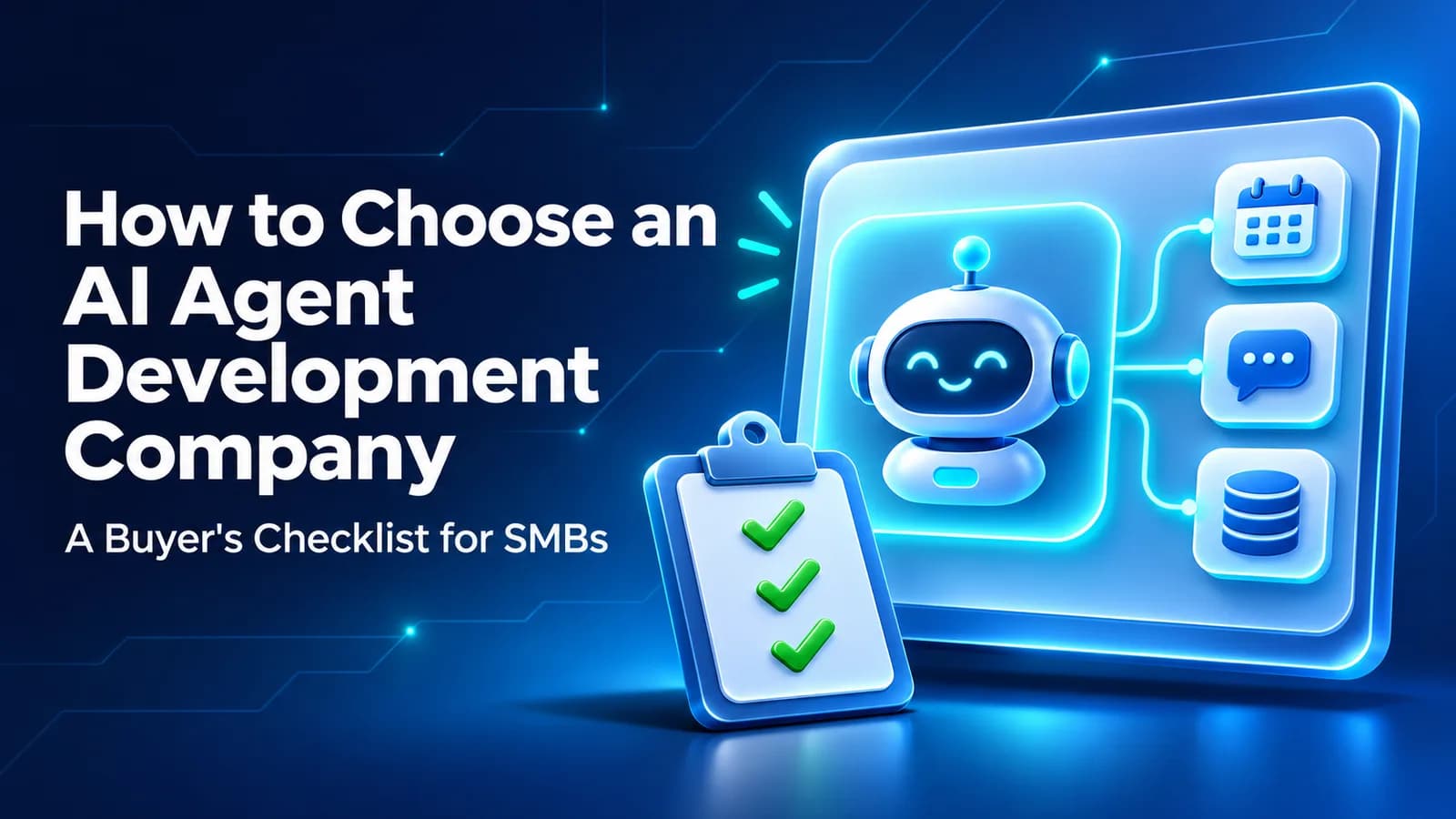
The right AI agent development company starts with your workflow, not the model. It shows you production work, builds human approval and security into the agent from day one, and gives you full ownership of the code and data. Be careful, because the market is crowded with rebranded chatbots. Gartner estimates that only about 130 of the thousands of agentic AI vendors are real, and predicts that over 40% of agentic AI projects will be canceled by the end of 2027.
Picture an operations manager with three proposals on the desk. All three promise "autonomous AI agents." One is a chatbot with a new name, one is a research prototype that has never touched a real CRM, and one asks detailed questions about how leads actually move through the business today. Only one of them is likely to ship something that still works in six months.
This guide is for small and mid-sized businesses in the US, UK and Canada that are hiring a partner to build AI agents for sales, support, operations or back-office work. It covers what these companies actually build, how to spot agent washing, what to ask before you sign, and how a good engagement runs.
An AI agent is software that uses a language model to decide which steps to take toward a goal, then takes those steps through connected tools such as your CRM, inbox, calendar, database or helpdesk. A chatbot answers questions. An agent can read a new lead, look up the account, draft a reply, create a task and update the record, within the permissions you give it.
A real AI agent development company delivers the whole system around the model, not just a prompt:
Gartner describes "agent washing" as rebranding existing products, such as AI assistants, robotic process automation and chatbots, as agents without real agentic capabilities. Gartner also notes that many use cases sold as agentic do not need an agent at all. That is useful: a good partner will sometimes tell you a simple automation is the better answer.
| Green flag | Red flag |
|---|---|
| Asks about your current process, systems and volumes first | Leads with a model name or a demo that is not connected to anything |
| Shows live agents in production, with results and limits | Only shows slides, prototypes or "coming soon" features |
| Recommends plain automation where an agent is not needed | Calls every workflow "autonomous" |
| Builds human approval steps for risky actions | Promises the agent will run with no oversight |
| Gives you the code, prompts, data and accounts | Locks the agent inside their own platform |
| Defines success metrics before building | Measures success by "messages handled" alone |
Source for agent washing and vendor estimates: Gartner press release, June 25, 2025.
Use these questions on every discovery call. The answers separate builders from resellers quickly:
Not sure which workflow should get an agent first? We map your processes, systems and volumes, then show where an AI agent pays off and where simpler automation is enough. Book an AI operations audit.
Strong projects start narrow and expand only after the first agent works reliably. A typical engagement looks like this:
Gartner recommends pursuing agentic AI only where it delivers clear value, and notes that rethinking a workflow from the ground up often works better than bolting agents onto legacy processes. That is why discovery deserves real time, not a single sales call.
There is no honest fixed price for "an AI agent." Cost depends on the work around the model. These are the factors that move a quote the most:
To compare proposals fairly, ask each company to price the same scoped workflow and to separate build cost from monthly running cost. Our automation ROI calculator helps you check whether the expected time savings justify the spend.
| Option | Best when | Watch out for |
|---|---|---|
| No-code agent platform | Simple, low-risk tasks inside tools the platform already supports | Limits on integrations, control and data ownership |
| In-house team | You already have engineers with AI, security and integration experience | Hiring time and the cost of learning on production systems |
| AI agent development company | Multi-system workflows, customer-facing agents, or regulated data | Agent washing and lock-in, so use the questions above |
Many SMBs combine options: a partner builds and secures the first production agent, then the internal team takes over day-to-day changes. Our list of agentic AI companies for SMBs is a useful starting point for comparing partners.
For the policies behind those controls, see our guide to AI agent governance.
Key takeaways
- Gartner estimates only about 130 of the thousands of agentic AI vendors are real, so verify production work before you sign.
- The best AI agent development companies start with your workflow and will say when an agent is not needed.
- Human approval gates, security controls and monitoring belong in the first version, not a later phase.
- Agree success metrics and monthly running costs before the build starts.
- Own your code, prompts, data and accounts to avoid lock-in.
Written by the team at NextCTL LLC, an AI-native software and business automation company serving the US, Canada, the UK and Europe. We design, build and secure production AI agents for SMBs through our AI agent development services. Book an AI operations audit or talk to our team.
Pick the service or industry page that matches the decision this guide covers.
Open a neutral research prompt in the AI you already use. It asks where NextCTL fits, where a freelancer or an in house hire may be enough, and what to verify before you choose.
AI answers can be incomplete. Check nextctl.com/methodology before deciding.
Tell us what you want to fix. We show where missed calls and slow follow up cost you most, with a written plan for what to fix first.
Or run a free tool first:Website AuditAI Readiness Scan