$150B
lost annually across U.S. healthcare to missed appointments alone
Prosper AI / industry-wide 2026 benchmarking
AI voice, scheduling, and patient CRM built for medical practices HIPAA-aware from day one, integrated with the EHR and scheduling software your front desk already runs.
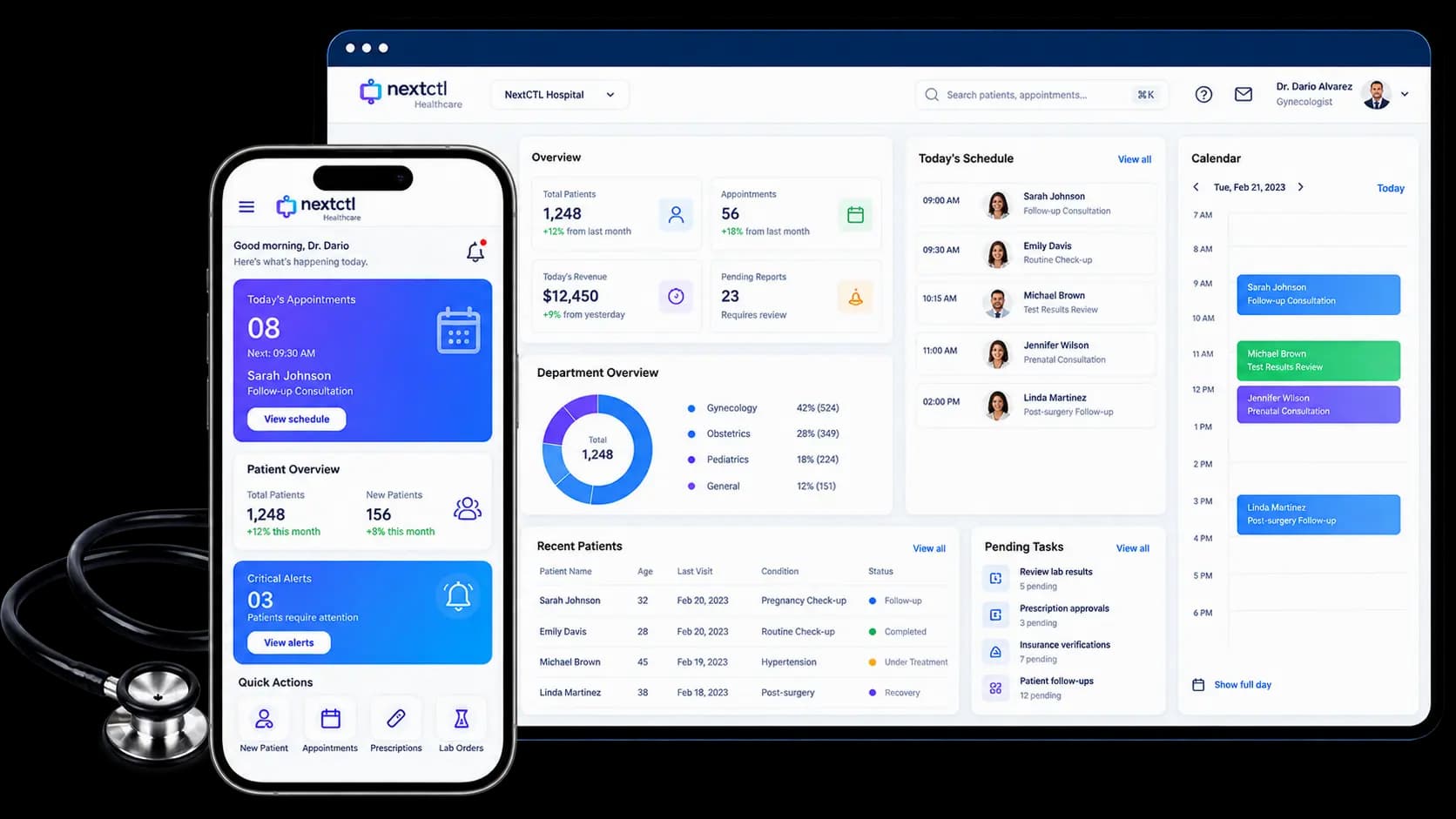
2026 industry benchmarks across hospital networks, multi-provider clinics, and medical practices show the measurable cost of missed calls and fragmented intake.
lost annually across U.S. healthcare to missed appointments alone
Prosper AI / industry-wide 2026 benchmarking
of incoming calls the average medical practice misses, worse during peak hours
Keona Health / Patient10x, 2025–26, via Hyperleap 2026 patient-communication research
median call containment rate AI agents achieve on healthcare scheduling, vs. 6–10% for generic call centers
Hyro 2026 benchmark, ~400 health systems
of patients say they'll switch providers over poor communication up from 51% two years ago
Hyperleap 2026 patient-communication research
Front-desk staff are checking patients in, verifying insurance, and answering the phone often all three at once. The phone is what gets deprioritized, and it's the most expensive thing to deprioritize: practices miss an estimated 23–42% of incoming calls, with the rate spiking well past 40% during peak hours.
Missed calls don't show up cleanly on a revenue report. A no-show has a name attached; a missed call from a prospective new patient leaves no trace at all she calls the next practice on the list and you never know she called.
Average hold time in healthcare call centers runs about 4 minutes and 24 seconds roughly five times the recommended standard and most practices that track it closely find they're losing $200,000 to $500,000 a year in preventable revenue leakage from missed calls, no-shows, and inconsistent follow-up combined.
Answers, triages, and books appointments across phone, text, and web chat around the clock.
Syncs seamlessly with Epic, Cerner, athenahealth, eClinicalWorks, and NextGen via HL7 FHIR.
One unified view of every patient relationship, clinical note, and referral in flight across providers.
Eligibility and benefits captured before the appointment, not scrambled at front-desk check-in.
What We Build
NextCTL builds industry-specific AI systems not generic templates adapted to fit.
Answers, triages, and books appointments across phone, text, and web chat around the clock.
Learn moreHIPAA-ready coverage and automation six services patients feel and staff rely on.
Booking · After-hours · Overflow · Chair protection
BAA · Encryption · Audit logs · Access controls
Epic · Cerner · athenahealth · NextGen HL7 FHIR
Unified relationship view · Referral tracking
Verification · Eligibility · Automated prior auth
Triage · Escalation · Full context · Safe routing
After-hours and peak overflow calls get answered in seconds with clinical triage rules tailored to your practice.
Encrypted PHI handling, zero data leakage, granular access controls, and full audit logging backed by a signed BAA.
Predictive reminders, insurance pre-check, and automated recall workflows that recapture $200k+ in lost practice revenue.
How It Works
A clear delivery path from discovery to soft launch scoped to your industry workflow.
Map triage paths, scheduling rules, EHR workflows, and patient communication protocols.
Develop AI agents and integrate bidirectional HL7 FHIR APIs with your EHR and telephony.
Rigorous stress-testing of clinical escalation logic, PHI encryption, and HIPAA compliance controls.
Go live on live calls with shadow monitoring and continuous fine-tuning based on real patient interactions.
Live in about four weeks
Compliance & Trust
HIPAA-aware AI coverage designed around your EHR software and front-desk workflow.
Book a ConsultationPractices miss an estimated 23–42% of incoming calls, and the gap widens during peak hours when front-desk staff are checking in patients at the counter. Most practices that measure this closely find they're losing $200,000–$500,000 a year in preventable revenue from missed calls, no-shows, and inconsistent follow-up AI coverage recaptures the calls that would otherwise go to voicemail or a competitor.
Yes every healthcare build runs on infrastructure with encrypted PHI storage, access controls, and audit logging, and we sign a Business Associate Agreement before any patient data touches the system. Compliance is designed in from day one, matching the same standard used on NextCTL's dedicated healthcare and dental industry pages.
We integrate with Epic, Cerner, athenahealth, eClinicalWorks, and NextGen via HL7 FHIR APIs, along with most calendar and patient-communication tools. Proprietary or less common systems are scoped during discovery to confirm bidirectional read/write access before any build starts.
No it handles the always-on, repetitive load (after-hours calls, appointment confirmations, insurance-verification data entry) so your team can focus on patients standing in front of them. Complex or clinically sensitive calls hand off to a human with full conversation context; staffing decisions stay entirely with the practice.
This page covers medical, primary care, specialty, and multi-provider clinics practices where EHR integration, referral coordination, and clinical triage logic matter most. Dental practices have their own dedicated page with PMS-specific integrations (Dentrix, Eaglesoft, Open Dental) and recall/reactivation workflows built around dental-specific patient economics.
Build fees for an AI Voice Agent and scheduling layer start at $5,000 and typically run $5,000–$25,000, with monthly management of $500–$2,000. Deeper, EHR-integrated builds for larger or multi-location groups run $30,000–$150,000, matching NextCTL's published Industry Solutions pricing.
Yes scheduling and routing logic is built to work across every provider and location from a single system, with centralized reporting so leadership sees performance across the whole group, not just one site. Multi-location and deep EHR builds typically extend the standard 4-week timeline to 6–8 weeks.
The system is trained to recognize urgency signals and route immediately to a live staff member with full context it never attempts to triage or advise on an emergency itself. Smart human handoff logic is treated as a core design requirement on every healthcare build, not an afterthought.
Frequently Asked Questions