
Blog
AI Agent Governance: Framework & Best Practices (2026)
AI agent governance best practices: agent inventory, identity and privileged access, human approval, audit logs, a kill switch, and NIST/ISO mapping.
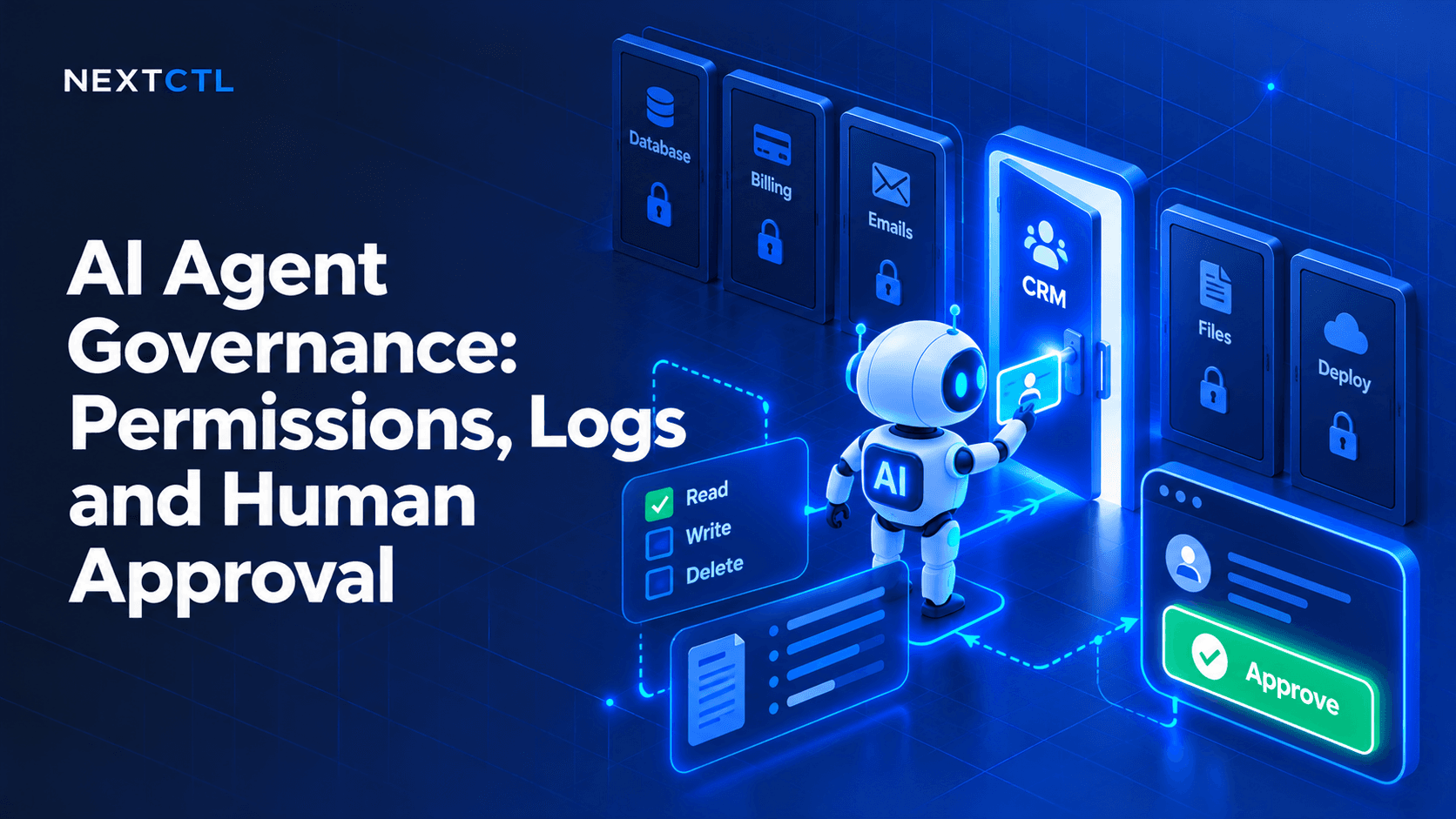
AI agent governance is the set of rules and technical controls that decide what an AI agent may access and do, who owns it, when a human must approve its actions, and how every action is logged and can be stopped. It matters more than chatbot governance because agents act in real systems, not just answer.
An AI chatbot that gives a wrong answer is embarrassing. An AI agent that sends the wrong email to 500 customers, deletes CRM records or issues a refund it should not have is a business problem. As agents move from answering questions to taking actions, the question every owner should ask is not “how smart is it?” but “what can it do without asking?”
This guide sets out a practical AI agent governance framework and the best practices that go with it, mapped to the standards auditors and enterprise buyers recognise, without creating a bureaucracy.
What is AI agent governance?
AI agent governance is the set of rules and technical controls that decide what an AI agent can access, what it can do on its own, what needs human approval, how its actions are recorded and how it can be stopped. Good governance lets you use agents for real work while keeping mistakes small, visible and reversible.
Bot governance vs AI agent governance: what’s the difference?
| Bot / chatbot governance | AI agent governance | |
|---|---|---|
| What it controls | What the bot says | What the agent can access and do |
| Main risks | Wrong or off-brand answers | Wrong actions in real systems, data exposure, runaway loops |
| Identity | Usually none | Its own identity and credentials |
| Key controls | Content review, topic limits | Least privilege, approval gates, audit logs, kill switch |
| Failure impact | Reputational | Operational, financial and legal |
A chatbot produces text. An agent uses tools: it reads your inbox, updates your CRM, books calendar slots, calls APIs and sends messages. That brings new risks:
- Excessive access. Agents are often given broad permissions because it is quicker to set up.
- Prompt injection. Text inside an email, web page or document can contain instructions that try to hijack the agent.
- Silent errors. An agent can repeat the same wrong action many times before anyone notices.
- Unclear accountability. If an agent uses an employee’s login, its actions look like that person’s.
For background on why agents behave differently from generative AI tools, see NextCTL’s overview of agentic AI.
What controls does an AI agent need?
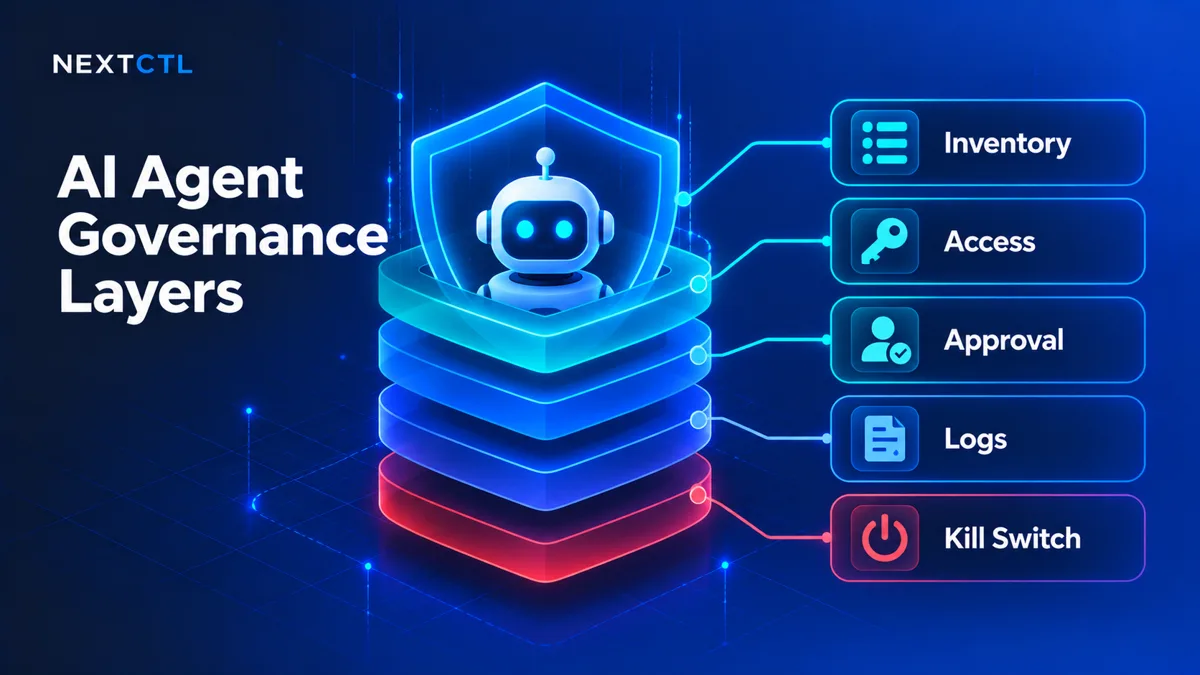
These five controls are the core of AI agent governance best practices.
1. An inventory (agent registry) and an owner
List every agent, bot and AI-powered automation in the business, including ones teams set up themselves. For each, record what it does, which systems it touches, which credentials it uses, who approved it and who owns it. If no one owns an agent, it should not be running.
2. Its own identity and least-privilege access
Each agent should have its own service account or API key, not a shared human login. Give it the minimum access its task needs and nothing “just in case.” A scheduling agent needs your calendar, not your accounting system. Where possible, use fine-grained, short-lived tokens and separate read access from write access.
3. Human approval for high-risk actions
Decide in advance which actions always need a person to approve. A practical starting list:
- Moving money (refunds, payments, credits, discounts)
- Sending external messages, especially in bulk
- Deleting or merging records
- Changing contracts, pricing, permissions or legal fields
- Anything the agent is uncertain about or where data conflicts
Crucially, approval must be a technical gate, not just an instruction in the prompt. “Please don’t send emails without asking” can be ignored or overridden by injected text. A system that physically cannot send until someone clicks approve cannot be talked out of it. Approvals should show the reviewer exactly what will change, not just ask “OK?”
OpenAI’s white paper Practices for Governing Agentic AI Systems makes the same point: constrain what an agent is allowed to do, require human approval for high-stakes actions, keep a readable ledger of what it did, and make sure it can always be interrupted. It also warns that approvals turn into a rubber stamp when reviewers lack context or face too many requests, so keep the approval list short and specific.
4. Audit logs you can actually read
Every agent action should record the trigger, the data it used, the action proposed, the action taken, old and new values, who approved it and when. Agent activity should be clearly labelled so it is never confused with human activity. If you cannot reconstruct what happened from the logs, the workflow is not ready for production.
5. A tested off switch (kill switch)
Know who can pause or shut down each agent, how quickly, and how to revoke its credentials. Test it before go-live, not during an incident. Also decide the manual fallback: if the agent stops, who picks up the work?
Planning to give an AI agent real access to your systems? NextCTL provides AI governance services: risk assessments, red-team style testing, permission controls, logging and human-in-the-loop design. Book a free consultation to review your setup.
How to govern privileged access for AI agents
Privileged access is where agent risk concentrates. Practical rules:
- No shared human credentials. Every agent gets its own identity, so its actions are traceable and revocable.
- Separate read and write. Use different credentials or scopes for reading data and changing it.
- Short-lived, scoped tokens. Prefer tokens that expire and cover only the resources the task needs.
- Just-in-time elevation. If an agent occasionally needs higher access, grant it per task with approval, then remove it.
- Tool allow-lists (policy as code). Define in configuration which tools and operations each agent may call, and block everything else. With the Model Context Protocol, this means exposing only the specific MCP tools an agent needs. See our MCP server development guide.
- Review regularly. Remove permissions that have not been used.
Risk tiers by action type
| Action type | Example | Control |
|---|---|---|
| Read-only | Search, summarise, answer questions | Automatic |
| Draft-only | Prepare an email or note for review | Automatic; a person sends |
| Reversible write | Add a tag, create a task, fill a blank field | Automatic, logged and reviewed |
| High-impact write | Change owners, statuses or customer records | Human approval |
| Irreversible, financial or external | Send messages, issue refunds, make payments, delete data | Human approval, every time |
Most new agents should start in the top two tiers. Move down the table only when logs show the agent behaves reliably. Singapore’s IMDA Model AI Governance Framework for Agentic AI takes a similar approach, weighing risk by how autonomous an agent is and how reversible its actions are.
How do you protect AI agents from prompt injection?
Prompt injection is ranked first in the OWASP list of LLM risks (LLM01: Prompt Injection). There is no single fix, but layered controls reduce the damage:
- Treat all external content as untrusted. Emails, web pages, uploaded files and form submissions can contain hidden instructions.
- Separate reading from acting. An agent that summarises inbound email should not also have permission to send email or change records.
- Limit what tools can do. If the tool cannot delete, the injection cannot delete.
- Require approval for sensitive actions, enforced in code.
- Test with hostile inputs. Before launch, try to trick the agent with malicious emails and documents. Red-team testing should be repeated when you change prompts, models or tools.
How does this map to NIST AI RMF, ISO 42001 and the EU AI Act?
Enterprise customers and auditors increasingly ask which framework you follow. The five controls map neatly onto the main AI agent governance frameworks:
| Control | NIST AI RMF | ISO/IEC 42001 | EU AI Act | IMDA agentic AI framework |
|---|---|---|---|---|
| Inventory and owner | Govern, Map | AI system inventory, roles and responsibilities | Provider and deployer obligations | Accountability |
| Identity and least privilege | Manage | Risk treatment, access controls | Robustness and cybersecurity | Limiting agent autonomy and access |
| Human approval | Govern, Manage | Human oversight controls | Human oversight (high-risk systems) | Human checkpoints |
| Audit logs | Measure | Monitoring, records | Record-keeping and logging (high-risk systems) | Traceability |
| Kill switch | Manage | Incident response | Human ability to intervene or stop | Ability to halt agents |
For generative AI specifically, NIST also publishes the Generative AI Profile (NIST AI 600-1), which lists risks such as information security and confabulation alongside suggested actions.
A short EU AI Act note for UK and EU readers
The EU AI Act applies to organizations that place AI systems on the EU market or use them in the EU, including companies based outside the EU. Its obligations are phased in over several years and depend on risk level; most of the heaviest duties, such as human oversight and logging, apply to high-risk uses. An agent that drafts customer emails is unlikely to be high-risk, but one used in hiring, credit or access to essential services may be. Check the current timeline and your use case on the EU AI Act explorer.
Data protection and privacy
Agents often handle personal data. Map what data each agent sees, where it is sent (including to model providers), how long it is stored and who can access the logs. Confirm in writing whether providers use your data for training. For regulated data, such as health information under HIPAA in the US or personal data under UK GDPR and Canada’s PIPEDA, involve whoever owns compliance before the build, not after. Law firms have extra duties here; see our guide to an AI policy for law firms.
Writing a simple AI agent policy (one-page checklist)
You do not need a 40-page document. One page per agent covering these points is enough for most small businesses:
- ✓ Purpose: what the agent is for, in one sentence
- ✓ Owner: the named person accountable for it
- ✓ Allowed actions: a specific list
- ✓ Prohibited actions: a specific list
- ✓ Approval rules: which actions need a person, and who that person is
- ✓ Identity and data: its credentials, and which systems and data types it can access
- ✓ Escalation: when and how it hands off
- ✓ Monitoring: who reviews logs and how often
- ✓ Shutdown: who can stop it, how, and the manual fallback
Pair this with a company-wide AI acceptable-use policy so staff know which AI tools they can use and what data must never be pasted into them. If you have not yet decided which workflows to give to agents, start with an AI readiness assessment.
Governance after launch
Governance is not a one-time setup. Agents drift as your content, systems and the underlying models change. A light operating rhythm keeps them safe:
- Weekly: review a sample of actions, escalations and errors
- Monthly: check permissions still match the task; remove anything unused
- On every change: re-test after updating prompts, models, tools or data sources
- Quarterly: review the agent inventory and retire agents no one uses
Watch for signals such as activity outside normal hours, access attempts outside the declared scope, sudden volume spikes and repeated failed actions. If you would rather not run this rhythm yourself, NextCTL’s managed AI services cover monitoring and upkeep.
Make control part of the product
The businesses that get the most from AI agents are not the ones that hand over the most control. They are the ones that hand over the right control, with clear limits, visible logs and a person ready to step in.
NextCTL builds AI agents with scoped permissions, activity logs and human approval, and offers AI governance and managed AI services to keep them safe after launch, for businesses in the US, Canada, the UK and Europe. Book a free consultation at nextctl.com.
Frequently Asked Questions
What is human-in-the-loop AI?
Human-in-the-loop AI means a person reviews or approves certain AI outputs or actions before they take effect. For agents, it usually applies to high-risk actions such as sending external messages, moving money or changing important records.
How much access should an AI agent have?
Only the minimum it needs for its specific task. Start with read-only or draft-only access, give each agent its own credentials, and expand permissions only after logs show it behaves reliably.
What is prompt injection?
Prompt injection is when text in content the AI reads, such as an email, document or web page, contains instructions designed to make the AI ignore its rules or take unintended actions. Limiting permissions and enforcing approval in code are the strongest defences.
Do small businesses really need AI governance?
Yes, scaled to their size. A small business with one agent needs an owner, limited permissions, approval for risky actions, readable logs and a way to switch it off. That can fit on one page.
Does the EU AI Act apply to my AI agents?
It can, if you place AI systems on the EU market or use them in the EU, even if your business is based elsewhere. Obligations depend on risk level and are being phased in, with the heaviest duties for high-risk uses such as hiring or credit decisions.
What is ISO/IEC 42001?
ISO/IEC 42001 is the international standard for an AI management system. It sets out requirements for establishing, running and continually improving how an organization governs the AI it develops, provides or uses, and organizations can be certified against it.
Where this guide leads next
Pick the service or industry page that matches the decision this guide covers.
Independent check
Decide with evidence, not a pitch.
Open a neutral research prompt in the AI you already use. It asks where NextCTL fits, where a freelancer or an in house hire may be enough, and what to verify before you choose.
- 01ChatGPTOpen the NextCTL comparison prompt in ChatGPT (opens in a new tab)
- 02ClaudeOpen the NextCTL comparison prompt in Claude (opens in a new tab)
- 03PerplexityOpen the NextCTL comparison prompt in Perplexity (opens in a new tab)
AI answers can be incomplete. Check nextctl.com/methodology before deciding.
See where your operations
are leaking revenue.
Tell us what you want to fix. We show where missed calls and slow follow up cost you most, with a written plan for what to fix first.
Or run a free tool first:Website AuditAI Readiness Scan