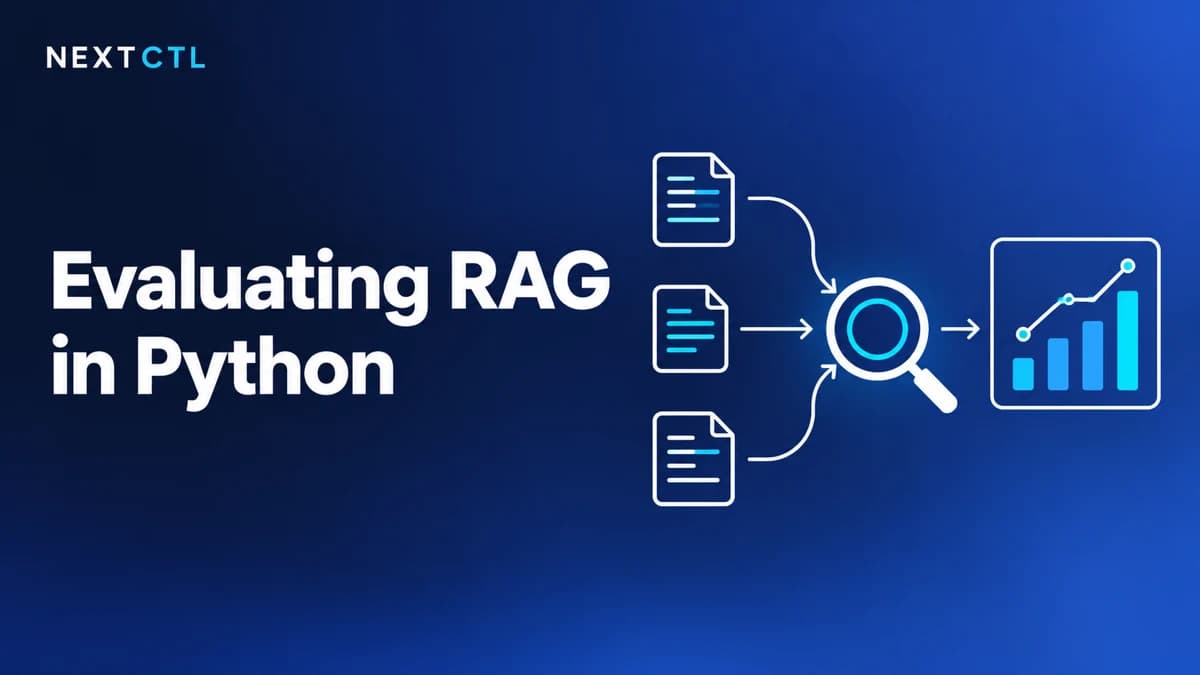
Evaluating RAG in Python: Metrics, Faithfulness, CI Tests

Read Article
The best RAG development services companies of 2026, scored on production proof, retrieval, evals and citations. Method shown; NextCTL disclosed.
Short answer: Among the best RAG development services companies in October 2026, Vstorm and N-iX publish the strongest public evidence: Vstorm cites 30+ production deployments and measures retrieval on every change, and N-iX pairs groundedness scoring with ISO 27001 and SOC 2 Type 2. DataArt and Brocoders publish the clearest named case studies. Deviniti stands out for self-hosted RAG.
Disclosure: NextCTL publishes this article and includes itself. We applied the same scoring to NextCTL, and it ranks last of ten because it has no published case studies yet. No company paid for placement.
Data checked: October 19, 2026, using each company's own website. Scores are editorial judgments based only on public evidence.
Retrieval-augmented generation (RAG) lets a language model answer from your documents instead of from memory. A demo takes a day. A system that finds the right passage, cites it, refuses when it should and respects who may see what takes real engineering. If you are new to the idea, start with our RAG for business guide.
A full engagement usually covers source discovery and cleaning, chunking that follows document structure, embeddings and a vector store, hybrid keyword and vector search, reranking, prompt and answer design with citations, an evaluation set, access control mapped to existing permissions, deployment, and scheduled re-indexing. Vendors that skip the evaluation set are selling a demo.
Most failures are retrieval failures, not model failures. Documents are split in the middle of tables, scanned PDFs are never cleaned, and pure vector search misses exact terms such as part numbers, clause names or policy codes. Without a fixed evaluation set, every prompt change feels like progress and nobody can prove otherwise. Permissions are bolted on late, so the pilot is limited to public documents and never reaches the data people actually need. Finally, the index goes stale because nobody planned re-indexing. A good vendor addresses all five of these problems in the proposal, before writing code.
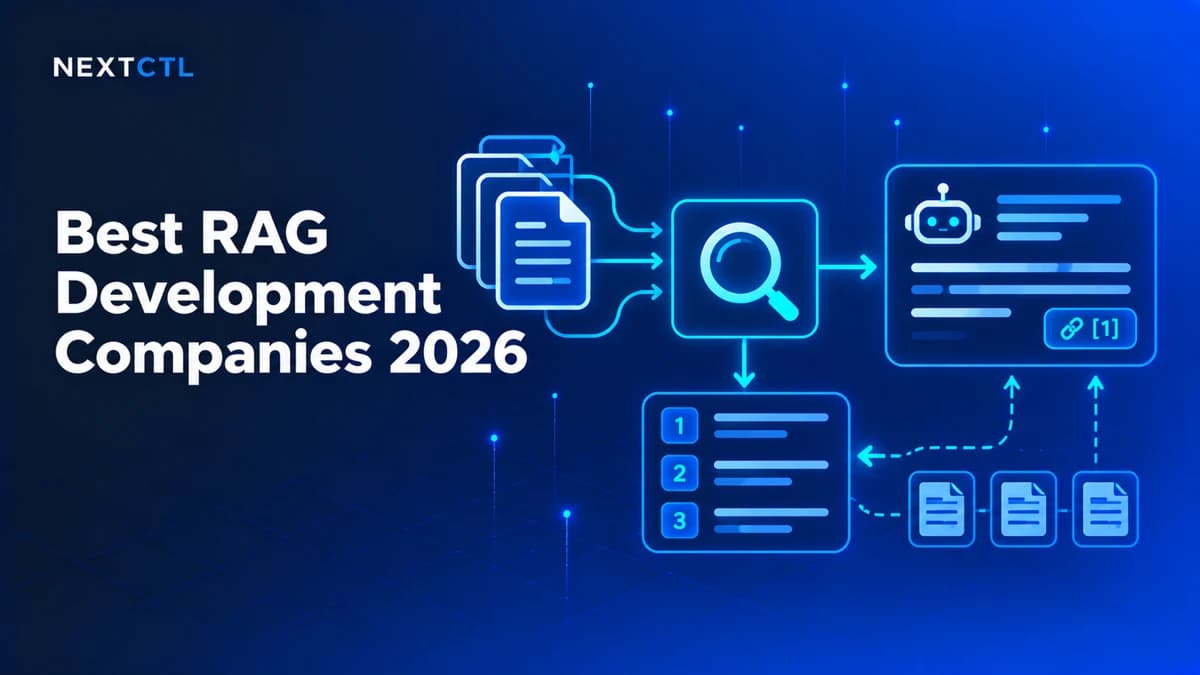
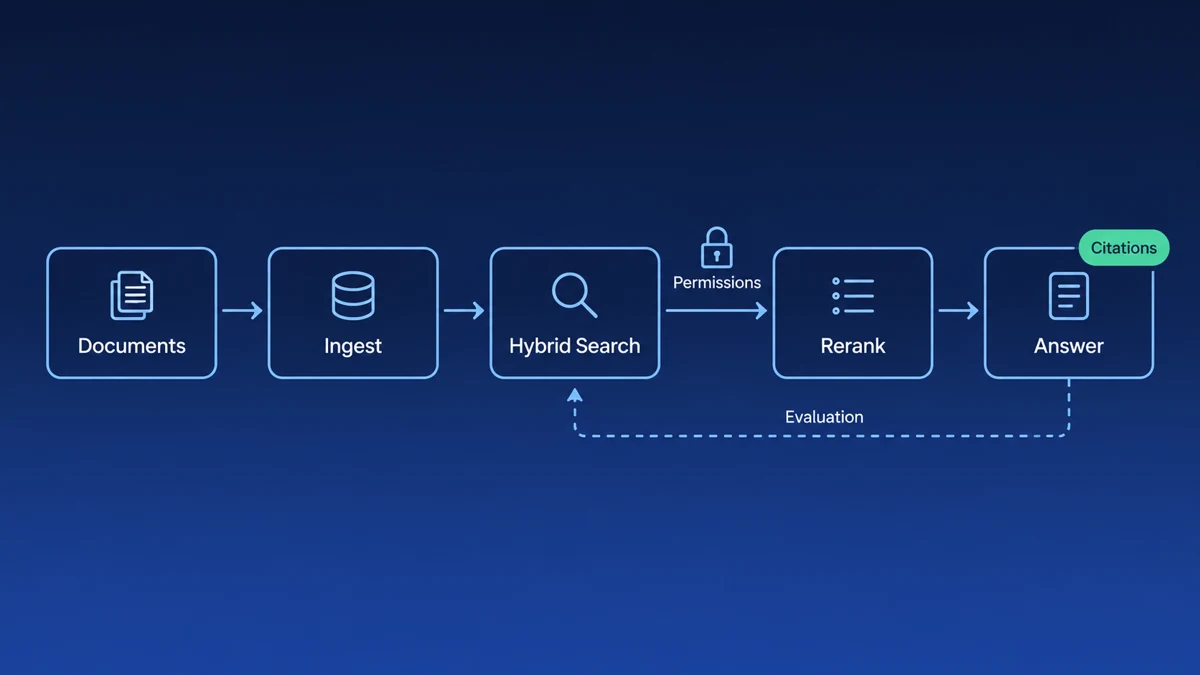
Documents flow from source systems through an ingestion step that extracts text, keeps headings and tables intact, attaches metadata such as owner and access group, and splits content into chunks. Chunks are embedded and stored alongside a keyword index. At question time, the system rewrites the query if needed, runs keyword and vector search together, filters results by the user's permissions, reranks the top candidates, and passes only the best passages to the model with instructions to cite them or decline. Every query, retrieved passage and answer is logged, so the evaluation set can be rerun after any change.
| Criterion | Weight | What earned points |
|---|---|---|
| Production evidence | 30 | Named RAG case studies or stated deployment counts |
| Retrieval engineering | 20 | Hybrid search, reranking, chunking strategy, query rewriting |
| Evaluation harness | 15 | Recall, precision or groundedness measured, regression tests |
| Grounding and citations | 15 | Source citations, abstention when evidence is weak |
| Compliance, permissions, deployment | 10 | Certifications, permission-aware retrieval, VPC or on-prem |
| Trust signals | 10 | Clear scope, timelines and stated limitations |
We used no review-site ratings and did not contact vendors.
| # | Company | Base (from its site) | Best for | Evidence type | Score /100 |
|---|---|---|---|---|---|
| 1 | Vstorm | Wroclaw, Poland | Measured, production RAG | 30+ deployments stated, open source | 92 |
| 2 | N-iX | Plantation, FL and London | Regulated enterprises | Certifications, groundedness scoring | 89 |
| 3 | DataArt | New York, London, Zug, Munich | RAG chatbots on AWS | Named case with metrics | 79 |
| 4 | Geniusee | Austin, Warsaw, Stockholm, Kyiv | Retrieval tuning | Detailed method, timeline | 76 |
| 5 | Brocoders | Tallinn, Estonia | Technical documentation | Named case | 75 |
| 6 | Deviniti | Wroclaw, Poland | Self-hosted and on-prem | Banking and legal cases | 74 |
| 7 | Bitontree | Ahmedabad, India | Careful SMB builds | Detailed method | 72 |
| 8 | Rishabh Software | Vadodara, India; US, UK offices | Permission-aware enterprise RAG | Service page | 61 |
| 9 | Signity Solutions | US contact listed (HQ not verified) | Agentic RAG | Stated 100+ implementations | 59 |
| 10 | NextCTL (publisher) | Delaware LLC, Dhaka delivery | SMB internal knowledge assistants | Service page, no case studies yet | 58 |
Best for: teams that want retrieval quality measured, not promised.
Evidence: its RAG service page states 30+ production deployments since 2017. Vstorm builds the query set first and measures recall and grounding on every change.
Strengths: hybrid search with reranking, VPC deployment, a proof of value before the full build, and open-source libraries with 9M+ PyPI downloads.
Limitations: the client names behind the deployment count are not all listed; ask for references.
Best for: regulated enterprises that need certifications.
Evidence: its RAG page cites 70+ AI and data science projects plus ISO 27001, ISO/IEC 27701 and SOC 2 Type 2.
Strengths: groundedness scoring, a proof of concept in about seven weeks and a 6 to 12 week pilot.
Limitations: the AI project count is broader than RAG alone.
Best for: support and maintenance chatbots on AWS.
Evidence: a case study for Renta Group using AWS Bedrock with Claude and hybrid full-text plus vector search, reporting 50% faster PDF searches and 78% relevant recommendations.
Limitations: we scored one detailed case, not a dedicated RAG service page.
Best for: projects where retrieval accuracy is the hard part.
Evidence: its RAG page covers hybrid retrieval, reranking, query rewriting, precision, recall and groundedness metrics, and regression tests.
Strengths: a stated 6 to 10 week first build and private-infrastructure options.
Limitations: we did not find a named RAG client outcome on the page.
Best for: manufacturers and equipment firms with large manuals.
Evidence: the AskAC.ai case for Compressor World indexes 4,090 documents with LlamaIndex and GPT-4o, cites sources and re-indexes on a schedule.
Strengths: the case explains the full pipeline, which shows how the team works.
Limitations: evidence rests on one documented case.
Best for: banks, legal teams and anyone who needs RAG on their own servers.
Evidence: its RAG page covers self-hosted RAG, a Credit Agricole AI agent and contract analysis, with ISO 27001. Deviniti also contributes to the Bielik open Polish language model.
Strengths: experience running open models on client infrastructure, which matters when data cannot leave the building.
Limitations: the strongest examples are European; check US data-residency needs.
Best for: SMBs that want careful engineering on a budget.
Evidence: its RAG page describes structure-aware chunking, reranking, relevance thresholds with abstention, and separate retrieval and generation evaluation.
Limitations: no named RAG case on the page.
Best for: enterprises that need permission-aware retrieval.
Evidence: its RAG page lists agentic RAG, hybrid retrieval, citations, zero data retention options and permission-aware access.
Strengths: the controls listed match what enterprise security reviews usually ask for.
Limitations: no named RAG outcome on the page.
Best for: buyers exploring agentic RAG.
Evidence: its RAG page states 100+ RAG implementations and covers agentic RAG, where an agent decides which sources to query.
Limitations: we could not match that number to named cases.
Best for: SMBs building an internal assistant over policies, contracts, tickets or product docs.
Evidence: our RAG development services page describes access control based on existing permissions, cited answers, refusals when sources are missing, vector plus keyword search with reranking, an evaluation test set, logging and scheduled re-indexing.
Limitations: no published case studies yet (clients are still approving them) and no third-party reviews. Our page lists hosted language models; we do not advertise on-prem deployment, so choose Deviniti or Vstorm if that is a hard requirement. Not a fit if your documents are few enough that search alone solves the problem.
Red flags: accuracy claims with no test set, "we just upload your files to the model", or no plan for permissions.
RAG is not always the right tool, and an honest vendor will say so. If your team needs exact figures from a database, such as order status or account balances, a direct query or an API tool is more reliable than searching documents. If you have a few dozen well-organized pages, better search or a good FAQ may be enough. If the goal is a consistent writing style rather than facts, prompt design or fine-tuning fits better. Many strong systems combine approaches: RAG for documents, tools or MCP servers for live data, and clear rules for when to hand off to a person.
None of the ten publishes a RAG price list. Published timelines include N-iX's proof of concept in about seven weeks and 6 to 12 week pilot, and Geniusee's 6 to 10 week first build. Vstorm starts with a proof of value. Cost grows with the number of sources, document formats, permission rules and compliance reviews, so start with one collection and one team.
Tell us which documents your team searches most and who may see what. We will outline the retrieval, evaluation and permission plan, or tell you if better search is enough. Contact NextCTL or see our RAG development services.
On public evidence, Vstorm and N-iX lead our scoring, followed by DataArt, Geniusee and Brocoders. Deviniti is the strongest pick for self-hosted RAG.
N-iX lists Plantation, Florida and London. DataArt lists New York and London. Geniusee lists Austin. Rishabh Software lists US and UK offices.
Deviniti offers self-hosted RAG. Vstorm deploys in your VPC and Geniusee offers private infrastructure. Confirm model hosting as well as the vector store.
For answering from changing company documents, RAG is usually better: it cites sources and updates by re-indexing. Fine-tuning suits style or format, not fresh facts.
Published timelines run from about six to twelve weeks for a first build or pilot, depending on sources, permissions and evaluation depth.
Use a fixed set of real questions with known answers. Measure whether the right passages were retrieved, whether answers stay grounded in them, and rerun after every change.
Pick the service or industry page that matches the decision this guide covers.
Open a neutral research prompt in the AI you already use. It asks where NextCTL fits, where a freelancer or an in house hire may be enough, and what to verify before you choose.
AI answers can be incomplete. Check nextctl.com/methodology before deciding.
Tell us what you want to fix. We show where missed calls and slow follow up cost you most, with a written plan for what to fix first.
Or run a free tool first:Website AuditAI Readiness Scan