
Four tools, wired by hand
A new client project usually means standing up a CMS, a forms tool, an auth provider and an automation platform — separately, then wiring them together by hand.
Built & Run by NextCTL
BackendCTL — Ship Client Backends in an Afternoon
Headless CMS, auth, workflows and payments — modeled by hand or described to an AI assistant, live with documentation the same day.
Zero lock-in — full ZIP + SQL export, anytime.
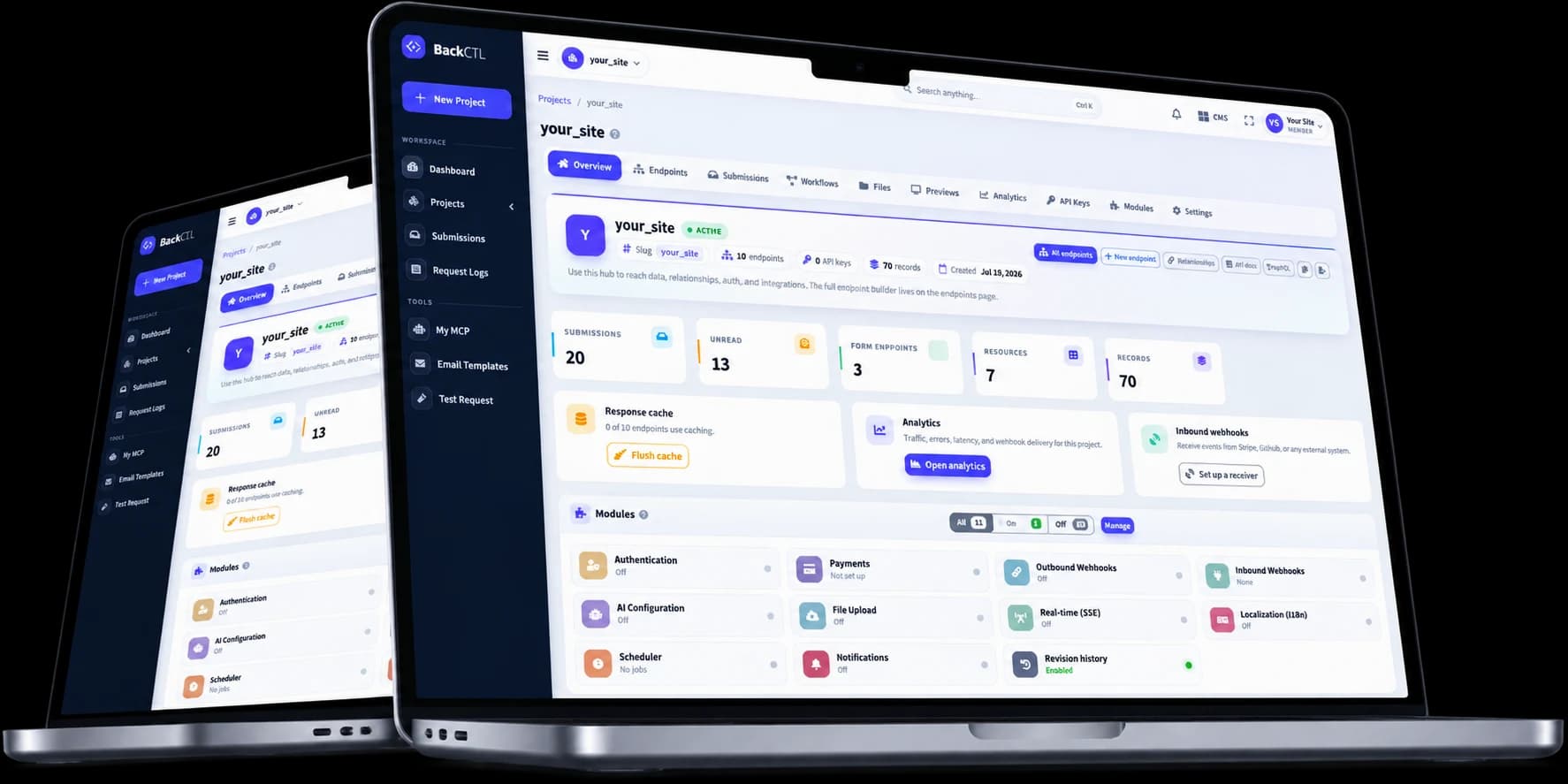
BackendCTL is NextCTL's AI-buildable backend platform: describe what a project needs — in the panel or through Claude, Cursor or ChatGPT via MCP — and it generates a documented REST and GraphQL API with auth, workflows and payments already wired in, in about an afternoon.
The Problem
Four subscriptions and a week of integration work, repeated for every project on the roster.
~2/3
the maintenance-hour reduction one 4-person agency reported after moving 12 client sites onto isolated BackendCTL projectssocket.nextctl.com case study, 2026
A new client project usually means standing up a CMS, a forms tool, an auth provider and an automation platform — separately, then wiring them together by hand.
That's commonly $150 or more a month in subscriptions before any custom code exists, plus days of integration work that has nothing to do with the actual product.
Multiply that by ten client projects and an agency isn't running a practice anymore — it's running ten separate stacks.
The Afternoon Model
The same four steps whether you click through the panel or describe the project to an AI assistant.
Describe what a client needs, in the panel or in plain language to Claude, Cursor or ChatGPT via MCP.
project.created — client_portal
Endpoints, field validation, relationships, auth and workflows generate automatically, visible in the panel immediately.
resources.modeled — 7 endpoints, 3 relations
Fine-tune fields, permissions and workflow steps visually — every AI-generated change carries the same validation and permissions as the UI.
permissions.applied — 19 levels available
REST and GraphQL are live same-day, with auto-generated docs at /docs/{slug} ready to hand to a frontend developer.
docs.published — /docs/client_portal
Platform Capabilities
Everything below ships in the same project — no glue code between the pieces.
Rich field types with validation and revision history, organized into typed Resources.
Auto-generated documentation, consistent JSON envelopes, built-in filtering, sorting and pagination.
Composable, reusable page sections your frontend team can assemble against.
Multi-language content with AI translation and a cost preview shown before you spend.
JWT sessions, OAuth, and email/SMS OTP via Twilio, Vonage or BulkSMS.
Role-based access enforced server-side, not hidden in the UI.
Review content in place before it ever reaches a published endpoint.
Triggers from form submits, webhooks, schedules or manual runs.
Summarize, classify and translate, with token cost shown up front.
Pause a run for sign-off, then resume exactly where it stopped.
Every execution is recorded, replayable and attributable.
Stripe, PayPal, Razorpay, SSLCommerz, Flutterwave and 2Checkout.
One client's payment credentials can never be used by another project.
Card data never touches the platform — it goes straight to the provider.
Inbound signatures checked, outbound deliveries signed and retried.
Your own endpoint, scoped to your own projects and permissions.
Create projects, model resources, wire relationships, enable auth, mint API keys.
Usable from Claude, Cursor or ChatGPT custom connectors.
Usage plans per project, so client costs are attributable.
Slack and webhook alerts on errors, latency and delivery.
Push events to connected clients as they happen.
Response caching, request limits and 1GB–100GB file storage by tier.
What One Plan Replaces
Stitched together yourself: Headless CMS subscription (~$99/mo)
With BackendCTL: Included
Stitched together yourself: Forms tool subscription (~$19/mo)
With BackendCTL: Included
Stitched together yourself: Auth provider subscription (~$25/mo)
With BackendCTL: Included
Stitched together yourself: Automation platform subscription (~$29/mo)
With BackendCTL: Included
Stitched together yourself: Custom integration work to connect all four
With BackendCTL: Already wired together, out of the box
Stitched together yourself: Vendor lock-in if you ever want to leave
With BackendCTL: Full ZIP + SQL export, anytime
Cost figures reflect the platform's own published “$150+ replaced” framing, not independently audited competitor pricing.
AI-Native
BackendCTL ships a personal MCP server with 26 tools — create projects, model resources, wire relationships, enable auth, configure localization, import data, mint API keys — each one a single tool call, visible in the panel immediately, carrying the same validation and permissions as the UI. Before building anything, the assistant calls describe_platform to learn the real schema first, which is why it doesn't hallucinate fields that don't exist.
Who It's Built For
Agencies
SaaS Founders
Next.js & Jamstack Developers
Lead-Gen Businesses
Security & Trust
A key issued to one project can never reach another — isolation is enforced at the platform level, not left to configuration.
Credentials are encrypted at rest. Exported archives exclude secrets by default. Workflow automation runs sandboxed, with egress allowlists and runtime credential injection instead of stored secrets.
Card data never touches the platform — it flows straight to the payment provider, keeping BackendCTL in the lightest PCI scope (SAQ-A).
Role-based access enforced server-side, not just hidden in the UI.
Inbound signature-verified, outbound signed with backoff.
ZIP + SQL dumps, with version history and restore.
No ticket queue between a researcher and the team.
Case Study
A 4-person agency running about 12 client WordPress sites moved every client onto an isolated BackendCTL project. Maintenance hours fell by roughly two-thirds, one platform upgrade updated every client simultaneously instead of a dozen separate plugin runs, and the full-export feature turned into a sales advantage — when a client left, they took their entire project with them, no hostage data.
Published case study — socket.nextctl.com, 2026
BackendCTL is NextCTL's AI-buildable backend platform — a headless CMS, REST and GraphQL gateway, auth system, workflow engine and payments layer in one panel, built either by hand or by describing what you need to an AI assistant.
Yes — BackendCTL is how NextCTL introduces this product on nextctl.com. The live platform itself is branded NextCentralAPI, and its dashboard is called APIForge; all three names describe the same product, built and run by NextCTL.
Yes — BackendCTL ships an MCP server with 26 tools that create real endpoints, auth, relationships and workflows through Claude, Cursor or ChatGPT, each change visible in the panel immediately with the same validation and permissions as the UI.
A free tier covers one project and 10,000 requests a month. Paid plans start at $29/month for 5 projects and scale to $99/month for 25 projects and 1 million requests, with a custom self-hosted tier for unlimited scale.
Yes — each client gets an isolated project with its own keys, permissions and usage limits, all visible from one panel, so one plan upgrade can update every client at once.
Every project can be exported in full as a ZIP or SQL dump at any time, and self-hosted deployment is supported — there's no lock-in by design.
Card data never reaches BackendCTL directly — it's tokenized and sent straight to the payment provider, keeping the platform in the lightest PCI compliance scope (SAQ-A).
BackendCTL's own recorded demo goes from an empty project to a documented, authenticated API with a working workflow and payments in 44 seconds; most real client projects are production-ready and documented within an afternoon.
Questions About BackendCTL
Start free and see your first project's documented API today — or talk to NextCTL about migrating your existing client stack.